MAVRL

Learning Reward Functions from Multiple Feedback Types
with Amortized Variational Inference

1ETH AI Center  2Department of Computer Science, ETH Zurich  3Department of Informatics, University of Zurich
ICML 2026

Different Feedback Types Carry Complementary Information

Rich human feedback comes in many forms — preferences, demonstrations, ratings, stops — and is increasingly easy to collect. But combining these types so their complementary information is actually leveraged has remained an open problem. The key insight behind MAVRL: every feedback type is a noisy observation of the same underlying reward. MAVRL combines them all by encoding every type into a shared latent reward and decoding each one back — so their complementary signals are used jointly, with no manual loss balancing.

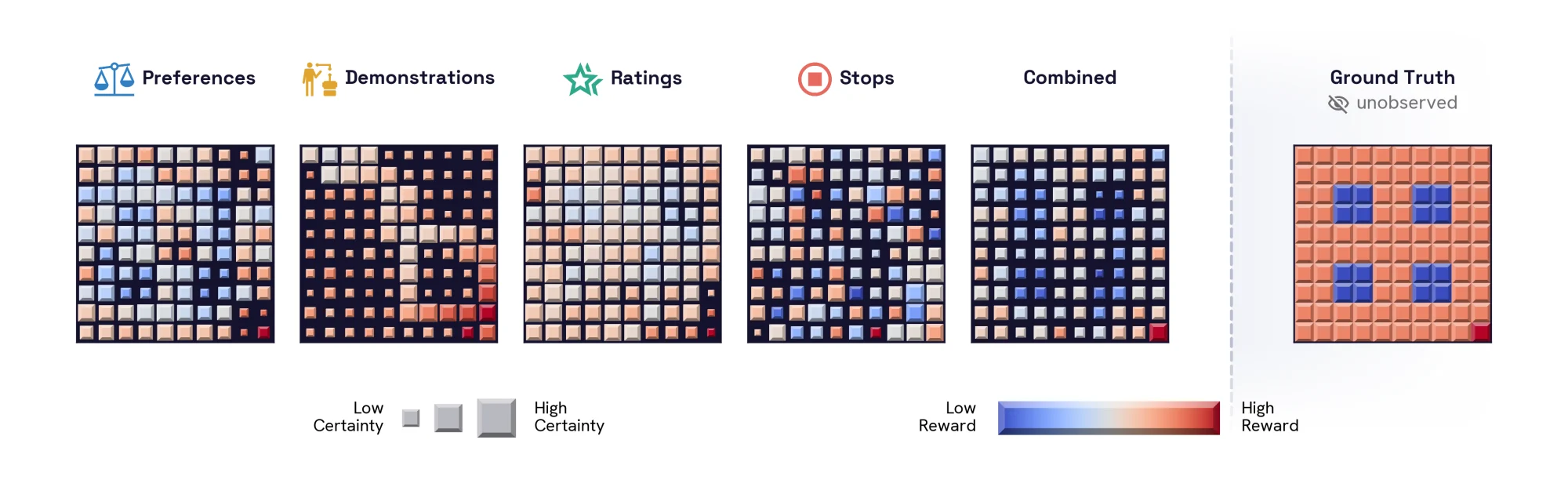
Inferred reward on a 10x10 grid from each feedback type individually and combined, next to the unobserved ground truth. Color encodes reward, cell size encodes certainty.

Inferred reward on a 10×10 grid (Grid-Trap): color encodes reward, cell size encodes certainty. Each single feedback type leaves gaps; combining all four recovers the unobserved ground truth with calibrated uncertainty.

Each feedback type induces a characteristic pattern in the inferred reward and uncertainty. Demonstrationsdemo yield low-uncertainty estimates along expert trajectories but leave large regions underdetermined. Preferencespref provide broader coverage but can over-reward frequently visited states. Ratingsrating reliably identify goals but offer limited landscape information. Stopsstop strongly constrain unsafe regions while providing little guidance on desirable behavior. Only their combination recovers the ground-truth reward.

Abstract

Reward learning typically relies on a single feedback type or combines multiple feedback types using manually weighted loss terms. Currently, it remains unclear how to jointly learn reward functions from heterogeneous feedback types — such as demonstrations, comparisons, ratings, and stops — that provide qualitatively different signals.

We address this challenge by formulating reward learning from multiple feedback types as Bayesian inference over a shared latent reward function, where each feedback type contributes information through an explicit likelihood. We introduce a scalable amortized variational inference approach that learns a shared reward encoder and feedback-specific likelihood decoders, trained by optimizing a single evidence lower bound.

Our approach avoids reducing feedback to a common intermediate representation and eliminates the need for manual loss balancing. Across discrete and continuous-control benchmarks, we show that jointly inferred reward posteriors outperform single-type baselines, exploit complementary information across feedback types, and yield policies that are more robust to environment perturbations.


How MAVRL Works

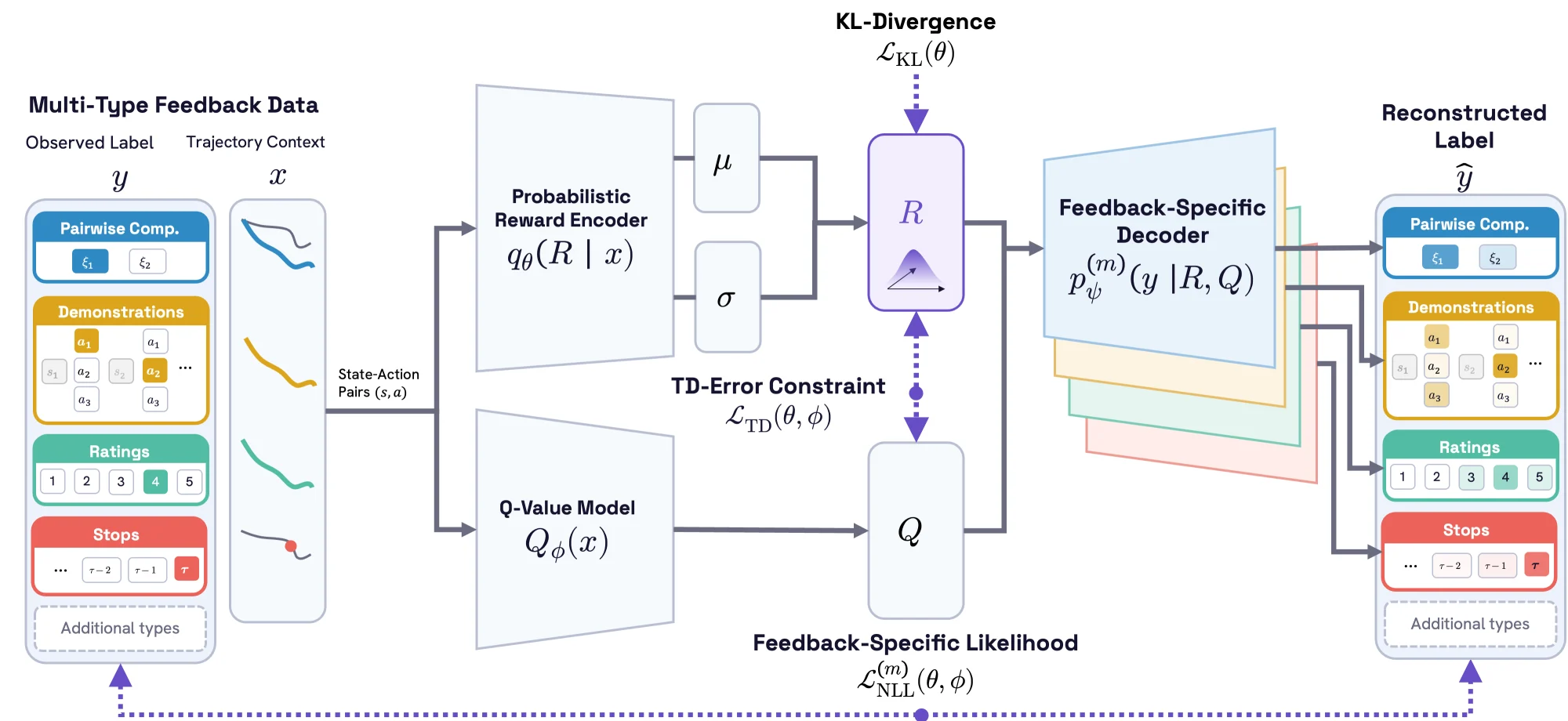
MAVRL formulates reward learning as Bayesian inference over a shared latent reward function. A shared probabilistic reward encoder and an auxiliary Q-value model feed feedback-specific likelihood decoders, each linking the latent reward back to one feedback type. Everything is trained jointly by maximizing a single evidence lower bound (ELBO). New feedback types plug in simply by adding a decoder — no loss balancing across modalities.

MAVRL architecture: multi-type feedback and trajectory context feed a shared probabilistic reward encoder and a Q-value model, producing a shared latent reward that feedback-specific decoders reconstruct into each feedback type.

A shared reward encoder maps heterogeneous feedback into one latent reward R; feedback-specific decoders reconstruct each type from R, all trained end-to-end under a single ELBO objective.


Combining Feedback Improves Performance

Across six environments spanning tabular grid worlds and continuous-control tasks, combining all four feedback types with MAVRL consistently achieves the strongest overall performance. No single feedback type dominates across all settings.

  • All four modalities combined achieves 100% normalized return in 3 of 6 environments and is the best or second-best method in 4 of 6.
  • MAVRL matches MCMC posterior inference quality at ~30× lower compute on grid environments, and scales to continuous-control tasks where MCMC is intractable.
  • Post-hoc reward averaging (training separate models per feedback type and ensembling) substantially underperforms joint inference, confirming that independent models miss cross-modal complementarity.
  • Equal-budget ablations confirm that performance gains reflect genuine complementarity, not simply more data.

Multi-Type Feedback Is More Robust

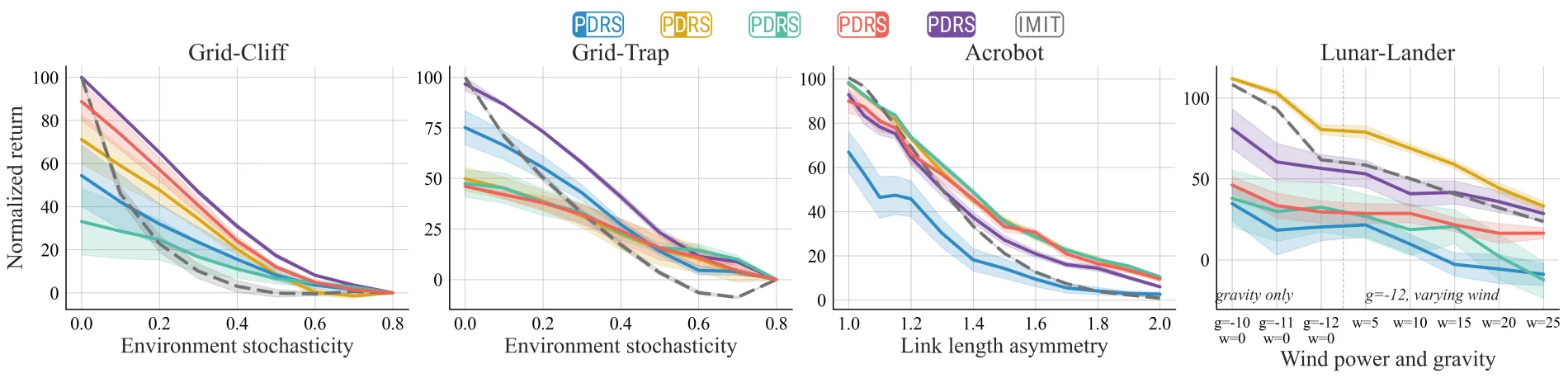
Reward functions learned from multiple feedback types degrade more gracefully when the environment changes at deployment. Under dynamics perturbations — increased stochasticity, altered physics, stronger wind — policies trained on multi-type rewards are generally more stable, outperforming single-feedback baselines in the grid environments and remaining competitive in continuous-control tasks.

Robustness under dynamics perturbations across four environments.

Normalized returns under increasing dynamics perturbations across four environments. Multi-type feedback (PDRS, bold) consistently degrades more gracefully than single-type baselines and imitation.

MAVRL is also resilient to feedback misspecification: when one feedback channel is corrupted (e.g., noisier preferences or miscalibrated ratings), the remaining modalities compensate. In 3 of 4 corruption scenarios, MAVRL retains ≥90% of its well-specified performance, while single-modality baselines collapse.


Citation

@inproceedings{baur2026mavrl, title={MAVRL: Learning Reward Functions from Multiple Feedback Types with Amortized Variational Inference}, author={Baur, Rapha{\"e}l and Metz, Yannick and Gkoulta, Maria and El-Assady, Mennatallah and Ramponi, Giorgia and Kleine Buening, Thomas}, booktitle={International Conference on Machine Learning (ICML)}, year={2026}, }